Narcissism Test: Understanding the Abuse Cycle of Love Bombing, Devaluation, and Discard
Are you caught in a confusing "hot and cold" relationship, experiencing intense highs followed by devastating lows? Many people find themselves trapped in a predictable yet bewildering pattern known as the narcissistic abuse cycle. This relentless emotional rollercoaster can leave you feeling disoriented, exhausted, and questioning your own sanity. What are the signs of a narcissist that create this destructive loop? Here, we'll break down the three distinct, agonizing phases – Idealization (Love Bombing), Devaluation, and Discard – revealing the behaviors and profound psychological toll of each. Understanding these patterns is the first, most crucial step toward regaining your footing and finding a path to clarity. If these dynamics feel familiar, taking a moment for self-reflection can be incredibly empowering. A narcissism test can help you gain some clarity by exploring these patterns further on our platform.
Understanding the Predictable Narcissistic Abuse Cycle
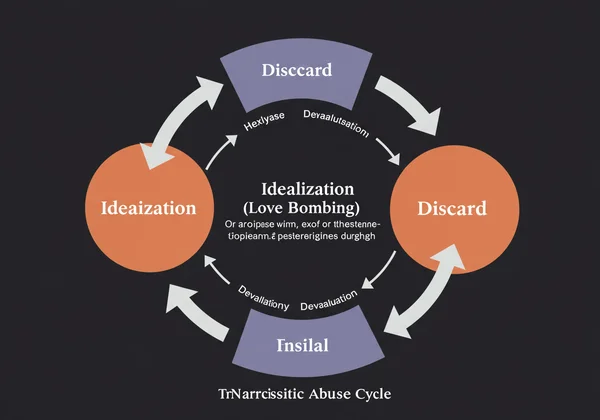
The narcissistic abuse cycle is a recurring pattern of behavior used by individuals with strong narcissistic traits to manipulate and control others in a relationship. It isn't just a series of random mood swings; it's a strategic, albeit often subconscious, sequence designed to draw you in, break you down, and keep you tethered. This cycle is fueled by the narcissist's deep-seated need for admiration and validation, often referred to as "narcissistic supply." When you understand this foundational motive, the otherwise chaotic behavior begins to make a painful kind of sense, and a narcissism test can be the first step in confirming these patterns.
Why Do Narcissists Engage in These Destructive Patterns?
At the core of narcissistic traits is a fragile sense of self-worth masked by an inflated ego. To maintain this facade, they require a constant stream of external validation. They create the abuse cycle to secure this supply. They idealize you to make you a source of admiration, devalue you to assert their dominance and control when they feel threatened, and discard you when you no longer serve their needs or when a new source of supply is found. It's a defense mechanism against their own inner emptiness and insecurity.
The Psychological Toll: Emotional Whack-a-Mole and Confusion
Living within this cycle is profoundly damaging. The constant switch between extreme affection and cold cruelty creates a state of cognitive dissonance, where you are forced to hold two contradictory beliefs at once: "This person loves me" and "This person is hurting me." This leads to confusion, anxiety, and a slow erosion of your self-esteem. You may find yourself constantly "walking on eggshells," trying to recreate the initial "perfect" phase, which feels like an exhausting and unwinnable game of emotional whack-a-mole.
Phase 1: The Enchanting Idealization & Love Bombing
The cycle almost always begins with the idealization phase, famously known as love bombing. This is the hook. During this stage, you feel like you’ve met your soulmate. They shower you with affection, attention, and praise, making you feel seen and cherished like never before. They mirror your interests, dreams, and values, creating an intense, almost supernatural connection. This isn't just a honeymoon phase; it's a targeted strategy to make you dependent on them for your sense of self-worth.
Spotting the Red Flags of Over-the-Top Affection
While a new romance is often exciting, love bombing feels different. It's too much, too soon. Red flags include extravagant gifts early on, constant and overwhelming communication, premature declarations of love, and pressure for immediate commitment. They might say things like, "I've never felt this way about anyone before," or "You're the only one who truly understands me." While flattering, this excessive adoration is often a prelude to control. For many, a narcissism test provides the first objective look at these red flags. Recognizing these patterns is key, and an online narcissism personality test can help you identify traits associated with this behavior.
Why the Intense Connection Feels So Addictive
The idealization phase is potent because it taps into our universal human need for love and belonging. The narcissist’s focused attention can feel deeply validating, creating a powerful biochemical bond similar to addiction. Your brain becomes accustomed to the dopamine rush of their praise and affection. This makes the subsequent withdrawal of that affection in the devaluation phase all the more painful and disorienting, compelling you to chase that initial high.

Phase 2: The Crushing Devaluation – When the Mask slips
Once you are hooked and committed, the dynamic shifts. The devaluation phase begins, often slowly and subtly. The person who once placed you on a pedestal now begins to find fault in everything you do. The constant praise is replaced by criticism, sarcasm, and dismissiveness. This is where the mask of perfection slips, revealing the insecurity and need for control underneath. The goal is to chip away at your self-esteem, making you easier to manipulate and more dependent on their approval.
Subtle Put-downs, Criticism, and Gaslighting Tactics
Devaluation often starts with backhanded compliments or "jokes" at your expense. It then escalates to direct criticism of your appearance, intelligence, or choices. A key tool in this phase is gaslighting—a manipulative tactic where they deny your reality, making you question your own perceptions and memory. They might say, "You're being too sensitive," "I never said that," or "You're imagining things." This insidious technique is designed to destabilize your sense of reality.
The Silent Treatment: Emotional Withdrawal and Neglect
Another common devaluation tactic is the silent treatment. Where there was once constant communication, there is now a deafening silence. They may ignore your calls and texts or become emotionally distant and unavailable. This withdrawal of affection is a form of punishment, used to create anxiety and force you to seek their approval. It's a powerful way for them to assert dominance and remind you that they are in control of the emotional climate of the relationship. To understand if these behaviors are part of a larger pattern, you can start your self-reflection with a confidential online tool.

Phase 3: The Painful Discard – A Swift and Brutal End
The final phase of the cycle is the discard. This occurs when you are no longer a reliable source of narcissistic supply, or when they have found a new target. The discard is often as sudden and intense as the idealization phase was, but in a brutally negative way. It can feel like the floor has been ripped out from under you. You are left confused, heartbroken, and often blamed for the relationship's demise.
Sudden Abandonment, Blame-Shifting, and Public Smear Campaigns
A narcissistic discard is rarely amicable. It often involves sudden abandonment with little to no explanation. The narcissist will typically rewrite history, portraying you as the unstable or problematic one. This blame-shifting protects their fragile ego from any sense of failure. In some cases, they may launch a smear campaign, spreading lies about you to friends, family, or colleagues to isolate you and control the narrative, ensuring they emerge from the relationship as the victim.
The "Hoovering" Attempt: Why They Might Try to Return
The discard is not always the end. "Hoovering" (named after the vacuum cleaner) is the narcissist's attempt to suck you back into the cycle. Weeks or months after the discard, they may reappear with apologies, promises to change, or reminders of the good times. This is not a sign of genuine remorse; it is a tactic to see if you are still a viable source of supply. If you respond, the cycle of idealization, devaluation, and discard is likely to begin all over again.
Breaking Free and Beginning Your Healing Journey
Escaping the narcissistic abuse cycle is challenging, but it is absolutely possible. Healing begins with knowledge and the validation of your own experience. It's about shifting your focus from "fixing" them or the relationship to healing yourself.
Disclaimer: This article is for informational purposes only and is not a substitute for professional medical advice, diagnosis, or treatment. The test on this website is an educational tool, not a diagnostic instrument. If you have concerns about your mental health or relationship dynamics, please consult a qualified mental health professional.
Recognizing the Cycle is Your First Step to Freedom
The most powerful step you can take is to recognize the pattern for what it is: a predictable cycle of manipulation, not a reflection of your worth. Naming the phases—love bombing, devaluation, discard—gives you a framework to understand your experience and depersonalize the abuse. If you are questioning whether these dynamics are at play, a free narcissism test can be a useful starting point for self-awareness.

Seeking Professional Support and Establishing No Contact
Healing often requires external support. A therapist specializing in narcissistic abuse can provide you with the tools to process the trauma, rebuild your self-esteem, and establish healthy boundaries. In many cases, the most effective boundary is "no contact," which means cutting off all communication with the individual to give yourself the space and peace needed to heal and break the cycle for good.
Understanding and Overcoming the Narcissistic Abuse Cycle
Your journey through the narcissistic abuse cycle is undeniably painful and isolating. Yet, simply understanding its mechanics is a powerful key to your liberation. By recognizing the predictable stages of idealization, devaluation, and discard, you empower yourself to break free from the confusion and begin your healing. You deserve a relationship built on genuine respect, consistency, and kindness.
Consider taking a narcissism test to further your self-understanding. If this article resonates with you, it may be time to look deeper into your relationship dynamics. Take the first step toward clarity and empowerment. Visit our free narcissism test to take our confidential test and begin your journey of self-discovery today.
Frequently Asked Questions About the Narcissistic Abuse Cycle
How to spot a hidden narcissist in a relationship?
A hidden, or covert, narcissist may not display the classic grandiosity. Instead, look for signs of passive-aggression, a subtle sense of superiority, a victim mentality, and a lack of empathy that is often masked by feigned concern. They often devalue you through subtle digs and by "playing the martyr."
What are the main signs someone might be a narcissist?
Key signs include a strong sense of entitlement, a constant need for admiration, a lack of empathy for others' feelings, manipulative behavior, and a tendency to exploit others for personal gain. In relationships, this often manifests as the cycle of love bombing followed by devaluation.
Do narcissists know they are intentionally manipulative?
This is complex. While some may be consciously aware of their manipulative tactics, many operate from a place of deep-seated defense mechanisms. Their primary driver is protecting their fragile ego and securing narcissistic supply, so they may rationalize their harmful behavior as justified, often lacking the self-awareness to see the damage they cause.
Can you ever have a healthy relationship with a narcissist?
A truly healthy, reciprocal relationship with someone who has strong narcissistic personality traits is extremely difficult, if not impossible. Healthy relationships require mutual respect, empathy, and the ability to take responsibility—qualities that are fundamentally lacking. Prioritizing your own well-being is often the healthiest choice. To better understand your patterns, exploring your own responses and boundaries is a crucial step.