Is Narcissism Genetic? What Research Says About Genes, Family, and Environment
If narcissistic traits seem to appear across several people in one family, it is natural to wonder: is narcissism genetic, learned, or some mixture of both? The short answer is that narcissism appears to have a genetic component, but genes do not write a fixed script. Family modeling, early experiences, culture, emotional learning, and individual choices can all shape how narcissistic traits show up over time. A private narcissism self-reflection tool can help you think about patterns in a calm way, but it should be treated as educational support, not a clinical assessment.
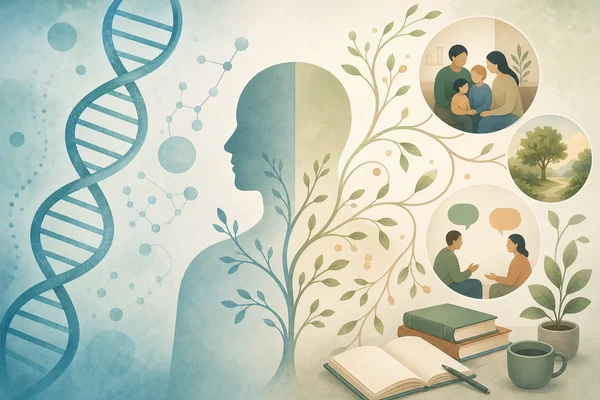
The Short Answer: Narcissism Can Run in Families, But It Is Not Destiny
Research on narcissism and personality disorders generally points to a both-and answer. Narcissistic traits can run in families partly because relatives share genes. They can also run in families because people grow up around similar emotional rules, parenting styles, conflict patterns, social expectations, and coping habits.
That distinction matters. When people ask whether narcissism is genetic, they sometimes mean, "Was this person born this way?" or "If my parent has narcissistic traits, will I have them too?" Current evidence does not support that kind of certainty. A family pattern can raise risk or familiarity, but it does not determine someone's character, relationships, or future behavior.
It also helps to separate everyday narcissistic traits from narcissistic personality disorder, or NPD. Many people show moments of self-focus, defensiveness, entitlement, or attention-seeking without meeting criteria for a clinical condition. NPD refers to a persistent and impairing pattern that a qualified professional evaluates through a mental health assessment.
What Genetic Research Actually Means
Most genetic research on narcissism uses behavioral genetics, especially twin and family studies. These studies compare how similar identical twins, fraternal twins, siblings, and relatives are on personality measures. If identical twins tend to be more similar than fraternal twins on a trait, researchers infer that genes likely contribute to differences in that trait across the studied population.
This is where the word "heritability" can be misleading. Heritability does not mean that a specific percentage of one person's narcissism came from DNA. It means that, within a studied group and environment, genetic differences help explain some of the variation between people.
Studies have reported different estimates depending on the sample, age range, narcissism measure, and model used. Some research finds moderate genetic influence for broad narcissistic traits, while other work suggests that particular dimensions, such as grandiosity or entitlement, may have different genetic and environmental patterns. A recent extended twin family analysis also emphasized that family resemblance in narcissism may be driven largely by genetic similarity, while non-shared environmental experiences still matter.
So the careful answer is: yes, there is likely a genetic component to narcissism in humans, but it is not a single-gene trait, and it cannot be read from a simple family tree.

Is Narcissism Inherited From Mother or Father?
Narcissism is not usually discussed as something inherited from only the mother or only the father. Personality traits are influenced by many genes, and a child receives genetic material from both biological parents. Even then, inherited tendencies are only one part of development.
Family stories can make the question feel more personal. Someone may notice that a father's side of the family seems status-focused, or that a mother's side has a pattern of criticism, emotional withdrawal, or entitlement. Those observations may be useful for reflection, but they cannot prove a single-parent source.
A better question is: what patterns are repeated in the family system? For example:
- How did adults handle criticism, shame, mistakes, and apologies?
- Were children praised only when they performed, looked impressive, or served a parent's image?
- Was empathy modeled during conflict, or did winning matter more than repair?
- Did family members learn to hide vulnerability behind superiority or control?
Those questions include both inherited temperament and learned behavior. They also leave room for change, which is important if you are trying to understand yourself rather than blame one parent.
Is Narcissism Genetic or Learned Behavior?
The most useful answer is that narcissism can be genetic and learned. Genes may influence temperament, emotional sensitivity, reward-seeking, impulsivity, confidence, social dominance, or how strongly a person reacts to shame. Those traits can make certain narcissistic patterns more likely, especially under stressful or reinforcing conditions.
Learning shapes the expression. A child may observe that admiration gets attention, vulnerability gets punished, or other people's needs are treated as obstacles. Over time, those lessons can become habits: exaggerating success, avoiding accountability, dismissing feedback, or using charm to regain control.
Environment can also push in different directions. Overindulgence, harsh criticism, neglect, unpredictable affection, and pressure to perform have all been discussed as possible contributors. None of these experiences automatically creates narcissism. Many people with difficult childhoods do not develop harmful narcissistic patterns, and many people with narcissistic traits had complex histories rather than one obvious cause.
For readers exploring their own patterns, a narcissistic-trait self-check can be one low-pressure starting point. It works best when paired with honest reflection, feedback from trusted people, and professional support when relationships or distress feel hard to manage.

What About Covert or Malignant Narcissism?
Searchers often ask whether covert narcissism is genetic or whether malignant narcissism is genetic. The evidence is not clean enough to assign separate inheritance answers to every informal subtype. Covert, vulnerable, grandiose, overt, and malignant labels are commonly used to describe different presentations, but they are not all formal categories in the same way.
It may be more accurate to think in terms of underlying dimensions:
- Grandiosity: feeling unusually special, superior, or deserving.
- Vulnerability: feeling easily shamed, overlooked, or criticized.
- Entitlement: expecting exceptions, admiration, or special treatment.
- Exploitativeness: using others to protect status or meet personal needs.
- Low empathy in conflict: struggling to notice or value another person's inner experience.
Different people can show different combinations. A person who appears quiet and wary may still feel entitled to special understanding. A person who appears charming and confident may become brittle when challenged. Genetics may influence broad personality tendencies, but the final pattern depends on development, relationships, choices, and context.
Is There Genetic Testing for Narcissism?
There is no simple genetic testing option that can tell whether someone is narcissistic or will develop NPD. Narcissism is a complex psychological pattern, not a single medical marker. Even when genes influence a trait, many genes may each contribute a tiny amount, and their effects depend on environment.
This is why direct-to-consumer genetic reports should not be used to label someone's personality. A DNA result cannot explain how a person handles empathy, accountability, intimacy, or conflict in daily life. Those patterns are better understood through behavior over time, context, self-awareness, and, when needed, evaluation by a qualified mental health professional.
If you are worried about yourself, focus less on genetic certainty and more on observable patterns. Do you struggle to apologize? Do you feel humiliated by ordinary feedback? Do you need admiration to feel steady? Do you dismiss other people's needs when you feel threatened? These questions are more useful than trying to locate a gene.
Five Common Habits People Associate With Narcissistic Patterns
People also ask about the "five main habits" of a narcissist. It is safer to frame them as common patterns associated with narcissistic traits, not a checklist for labeling someone. One person may show some of these patterns occasionally; another may show them persistently and harmfully.
Needing Admiration to Feel Stable
Some people rely heavily on praise, status, attention, or being seen as exceptional. When admiration drops, their mood or behavior may shift quickly.
Reacting Strongly to Criticism
Feedback can feel like humiliation rather than information. The person may attack, withdraw, blame-shift, or insist the critic is unfair.
Expecting Special Treatment
Entitlement can look like rules applying to others but not to them, or disappointment turning into anger when they do not receive priority.
Struggling With Empathy During Conflict
The person may understand empathy in calm moments but lose access to it when pride, shame, or control feels threatened.
Protecting Image Over Repair
Instead of apologizing or making amends, the person may focus on how they look, who is to blame, or how to regain the upper hand.
These habits can be learned, reinforced, or softened. Their meaning depends on frequency, intensity, impact, and willingness to reflect.

Can Narcissistic Traits Change?
Narcissistic traits can change, especially when a person develops insight, has motivation, and receives appropriate support. Change may be slow because narcissistic defenses often protect against shame, insecurity, or fear of being ordinary. When those defenses are challenged, the person may feel exposed rather than helped.
Therapy can support people who want to improve emotional regulation, empathy, accountability, relationship repair, and tolerance for feedback. There is no instant fix, and no article or online tool can replace professional care for serious mental health concerns. Still, people are not frozen by genetics alone.
For family members or partners, the goal is not to force someone else to change. A more realistic goal is to notice patterns, set boundaries, protect your own well-being, and decide what kind of relationship is healthy for you. If there is emotional abuse, threats, self-harm risk, or physical danger, seek immediate support from local emergency services or a qualified professional.
A Balanced Way to Think About Your Own Patterns
The question "is narcissism genetic?" can be useful if it reduces shame and opens the door to understanding. It becomes less helpful if it turns into fate, blame, or a label used to end the conversation. Genes may influence tendencies, but daily behavior is still shaped by awareness, practice, relationships, and support.
If you are reflecting on your own traits, try three gentle steps. First, separate identity from behavior: you are looking at patterns, not declaring your whole self good or bad. Second, compare your self-view with real feedback from people you trust. Third, notice what happens in moments of criticism, disappointment, jealousy, or conflict, because narcissistic defenses often become clearer under stress.
You can also use a free narcissism traits tool as a private reflection aid. Treat the result as a prompt for learning, not a final answer. If the topic feels emotionally heavy or affects your relationships, a licensed mental health professional can help you sort through it with more context and care.
FAQ
Can narcissism run in a family?
Yes, narcissistic traits can run in families. That may reflect shared genes, shared family habits, or both. Family resemblance does not mean every relative will develop the same traits, and it does not remove personal responsibility for behavior.
Is narcissism a mental illness?
Narcissistic traits are not automatically a mental illness. Narcissistic personality disorder is a recognized mental health condition involving a persistent, impairing pattern. A qualified professional is needed for a formal clinical assessment.
Is narcissism genetic from parents?
Parents can contribute genetic influence, but narcissism is not inherited in a simple one-parent or single-gene way. Parenting, modeling, peer experiences, culture, and individual temperament can all affect how traits develop.
Is narcissism learned or genetic?
It can be both. Genetic tendencies may influence temperament and emotional reactivity, while learned behavior shapes how a person seeks admiration, handles shame, responds to feedback, and treats others.
Is covert narcissism genetic?
There is not enough evidence to give covert narcissism a separate genetic rule. Covert or vulnerable narcissistic patterns may involve sensitivity to criticism, shame, and hidden entitlement, shaped by both temperament and life experience.
Can narcissistic traits improve?
Yes, traits can improve when someone has insight, motivation, consistent practice, and appropriate support. Improvement usually means better accountability, empathy, emotional regulation, and relationship repair rather than a quick personality reset.
What is the cause of narcissistic personality disorder?
The cause is considered complex. Genetics, temperament, parenting patterns, early experiences, culture, and neurobiological factors may all contribute. No single factor explains every case.